Nodal Responses Visualization (Pyvista)
[1]:
import openseespy.opensees as ops

import opstool as opst
import opstool.vis.pyvista as opsvis
Here, we use a built-in example from opstool, which is an example of a deck arch bridge model primarily composed of frame elements and shell elements.
[2]:
opst.load_ops_examples("ArchBridge2")
# or your model code here
[3]:
on_notebook = True
jupyter_backend = "static"  # or None
# on_notebook = False
# jupyter_backend = None
We use the opstool.vis.plotly.set_plot_props() function to predefine some common visualization properties, which will affect all subsequent visualizations of models, eigenvalues, and responses.
Model Geometry
[4]:
opsvis.set_plot_props(
    point_size=0,
    line_width=3,
    notebook=on_notebook,  # Set to False for practical use, display in a separate window
)
[5]:
fig = opsvis.plot_model(show_outline=True)
fig.show(jupyter_backend=None)
# fig.show()
Gravity Analysis
Apply the gravity load according to the mass in the model:
[6]:
ops.timeSeries("Linear", 1)
ops.pattern("Plain", 1, 1)
_ = opst.pre.gen_grav_load(factor=-9810)
Analysis Parameters:
[7]:
ops.system("BandGeneral")
# Create the constraint handler, the transformation method
ops.constraints("Transformation")
# Create the DOF numberer, the reverse Cuthill-McKee algorithm
ops.numberer("RCM")
# Create the convergence test, the norm of the residual with a tolerance of
# 1e-12 and a max number of iterations of 10
ops.test("NormDispIncr", 1.0e-12, 10, 3)
# Create the solution algorithm, a Newton-Raphson algorithm
ops.algorithm("Newton")
# Create the integration scheme, the LoadControl scheme using steps of 0.1
ops.integrator("LoadControl", 0.1)
# Create the analysis object
ops.analysis("Static")
Analysis and Saving Results
[8]:
ODB = opst.post.CreateODB(odb_tag=1)
for i in range(10):
    ops.analyze(1)
    ODB.fetch_response_step()
ODB.save_response()
OPSTOOL :: All responses data with _odb_tag = 1 saved in .opstool.output/RespStepData-1.nc!
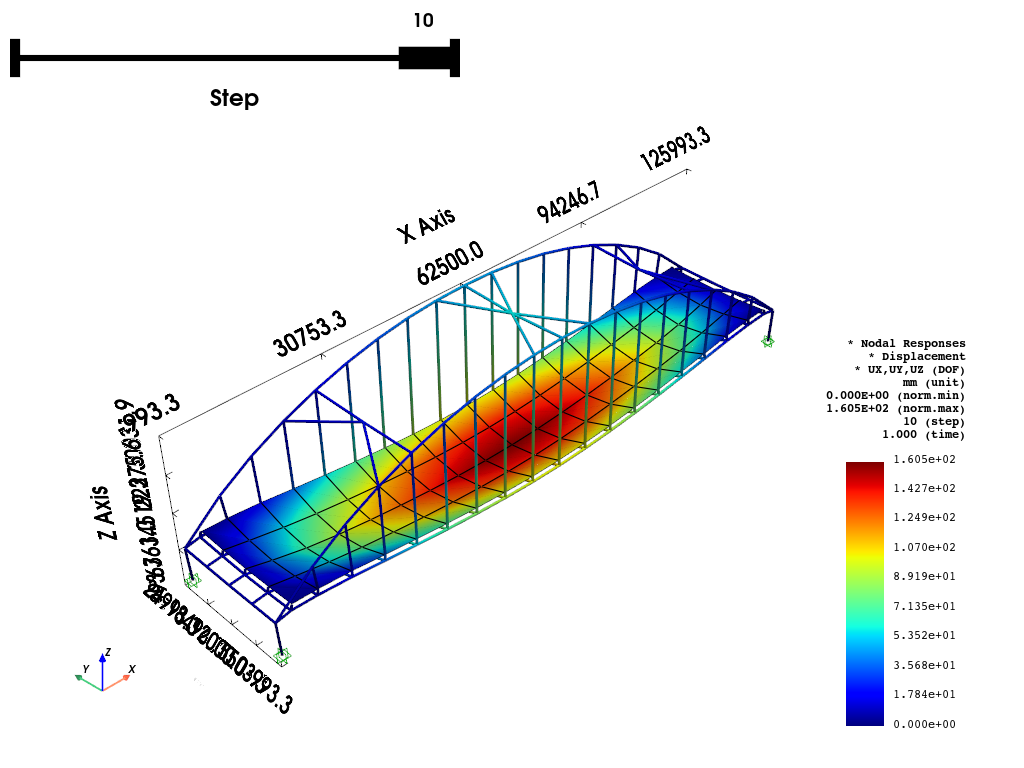
Nodal Responses Visualization
via Slides
[9]:
opsvis.set_plot_props(scalar_bar_kargs={"title_font_size": 12, "label_font_size": 12})

fig = opsvis.plot_nodal_responses(
    odb_tag=1,
    slides=True,
    resp_type="disp",
    resp_dof=["UX", "UY", "UZ"],
    unit_symbol="mm",
    show_outline=True,
    defo_scale="auto",
)
fig.show(jupyter_backend=jupyter_backend)
# fig.show()
OPSTOOL :: Loading response data from .opstool.output/RespStepData-1.nc ...
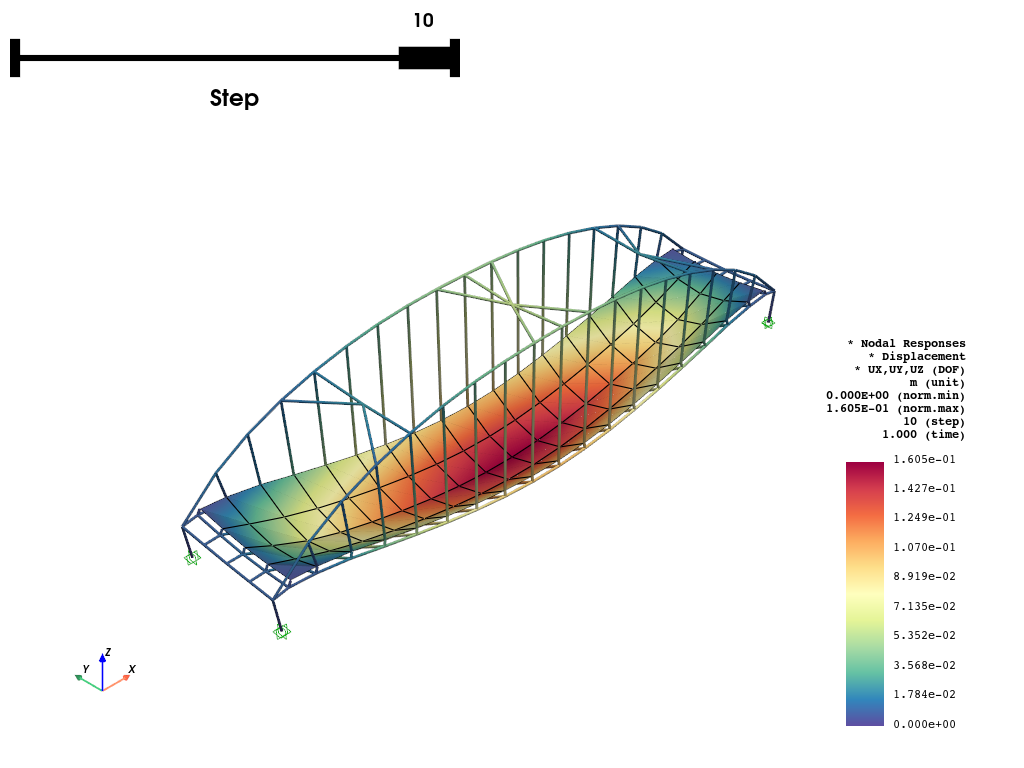
Change the unit dispaly
[10]:
opsvis.set_plot_colors(cmap="Spectral_r")
fig = opsvis.plot_nodal_responses(
    odb_tag=1,
    slides=True,
    step=9,
    resp_type="disp",
    resp_dof=["UX", "UY", "UZ"],
    unit_symbol="m",
    unit_factor=1e-3,
    defo_scale=100,  # you can adjust the deformation scale factor here
)
fig.show(jupyter_backend=jupyter_backend)
# fig.show()
OPSTOOL :: Loading response data from .opstool.output/RespStepData-1.nc ...
Animation
[11]:
fig = opsvis.plot_nodal_responses_animation(
    odb_tag=1,
    framerate=2,
    defo_scale=100,
    savefig="images/NodalRespAnimation.gif",
    resp_type="disp",
    resp_dof=["UX", "UY", "UZ"],
    unit_symbol="m",
    unit_factor=1e-3,
)
fig.close()
OPSTOOL :: Loading response data from .opstool.output/RespStepData-1.nc ...
Animation has been saved to images/NodalRespAnimation.gif!

Interacting with Pyvista
Since version 1.0.18, opstool provides a function get_nodal_responses_dataset that returns a pyvista UnstructuredGrid so that you can take advantage of all the functionality on it.
[12]:
import pyvista as pv

grid = opsvis.get_nodal_responses_dataset(
    odb_tag=1,
    step="absMax",
    resp_type="disp",
    resp_dof=["UX", "UY", "UZ"],
    defo_scale=100,
)
OPSTOOL :: Loading response data from .opstool.output/RespStepData-1.nc ...
The name of the scalar data to be activated will be the passed in resp_type:
[13]:
print(grid)
print(grid.active_scalars_name)
UnstructuredGrid (0x1ea079bd960)
  N Cells:    439
  N Points:   241
  X Bounds:   -8.820e+02, 1.259e+05
  Y Bounds:   -7.853e+01, 2.408e+04
  Z Bounds:   -8.045e+03, 2.775e+04
  N Arrays:   1
disp
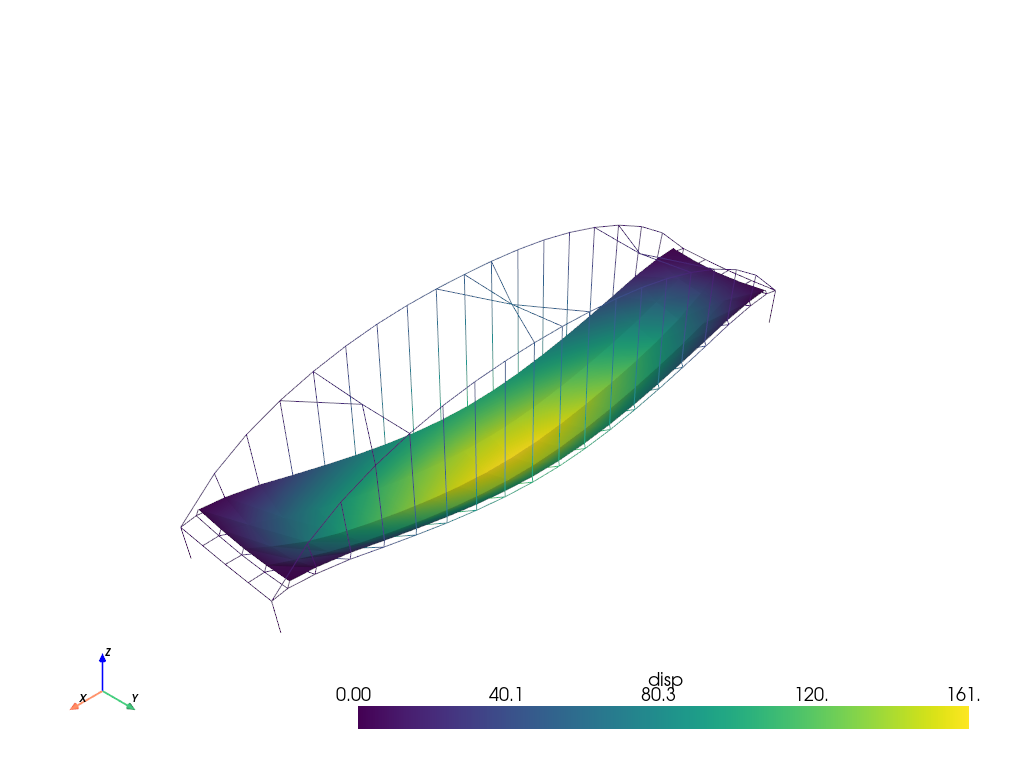
You can call the plot method directly:
[14]:
grid.plot(jupyter_backend=jupyter_backend)
You can also use the filters provided by pyvista:
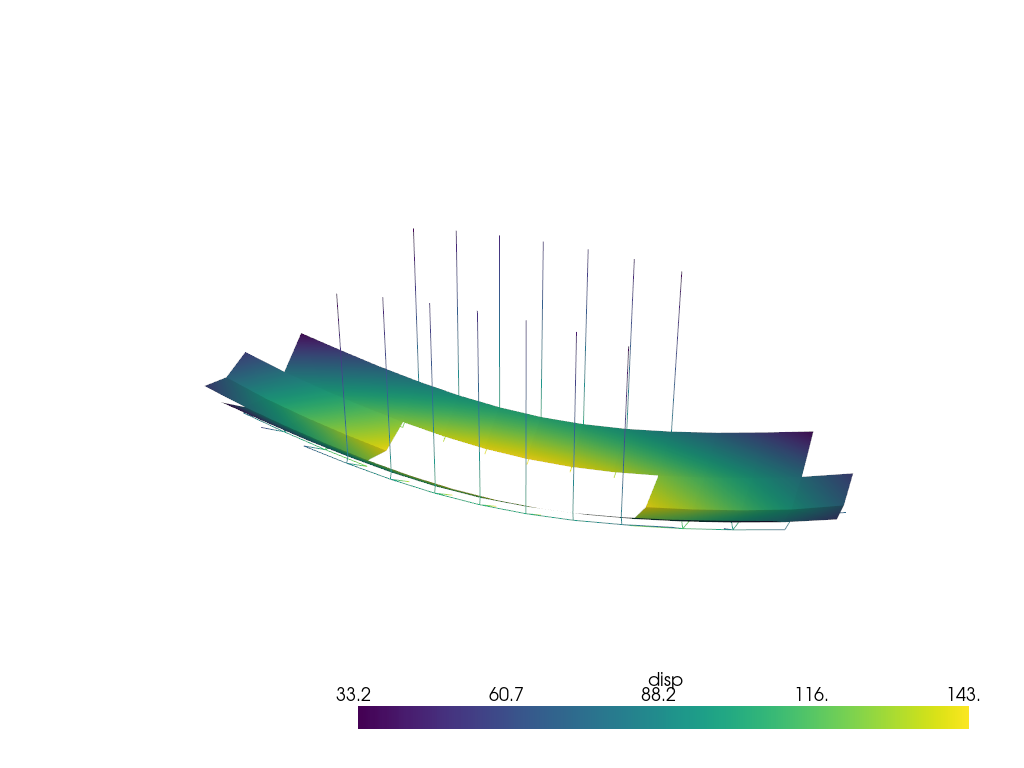
For example, using some common filters:
[15]:
# Apply a threshold over a data range
threshed = grid.threshold([80, 120])

p = pv.Plotter()
p.add_mesh(threshed)
p.camera_position = [-2, 5, 3]
p.show(jupyter_backend=jupyter_backend)
More details can be found in the PyVista Examples.