Note
Go to the end to download the full example code.
Excavation Supported by Cantilevered Sheet Pile Wall
This example is from file Excavation Supported by Cantilevered Sheet Pile Wall on the OpenSees website and has been converted using opst.pre.tcl2py The python model script can be found here excavation.py
import openseespy.opensees as ops
Load the FEM model function FEMmodel from file excavation.py.
[excavation.py](https://github.com/yexiang1992/opstool/blob/master/docs/examples/post/excavation/excavation.py)
from utils.excavation import FEMmodel

import opstool as opst
import opstool.vis.pyvista as opsvis

FEMmodel()
opsvis.set_plot_props(point_size=1, font_size=9)
opsvis.plot_model(show_node_numbering=True, show_ele_numbering=True).show()
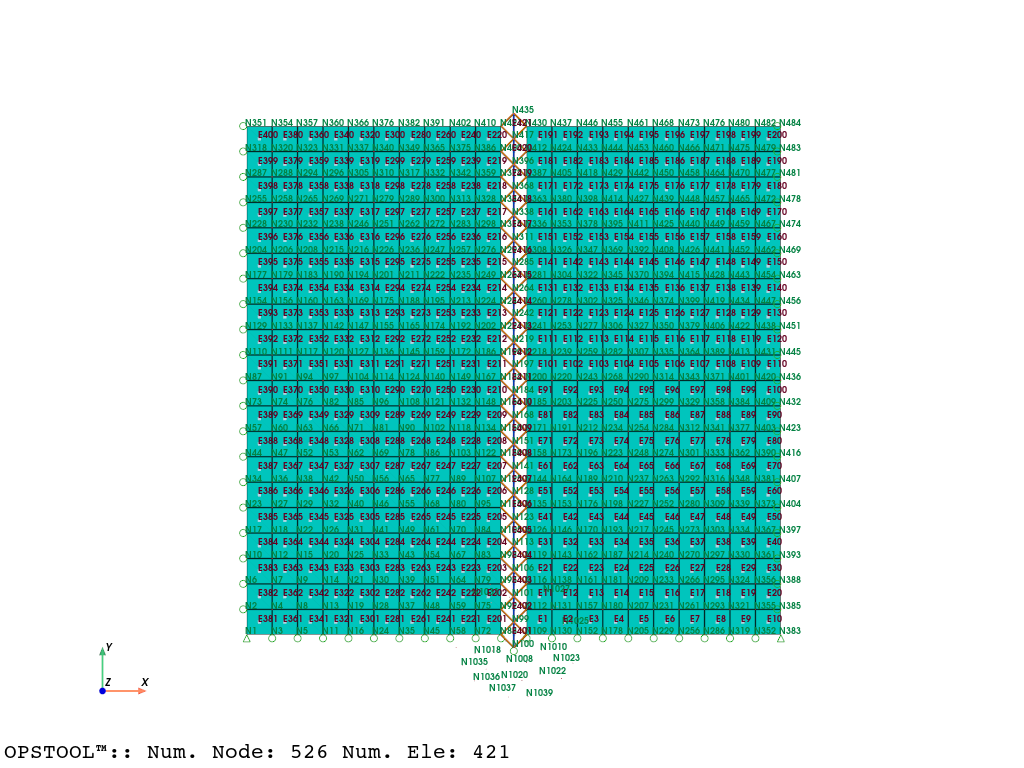
Create output database (ODB) file.
Since some elements and nodes will be removed in subsequent analyses, ensure that model_update=True.
ODB = opst.post.CreateODB(
    odb_tag=1,
    model_update=True,
    save_every=8,  # every 8 analysis steps will be saved
    compute_mechanical_measures=True,
    project_gauss_to_nodes="copy",
)
GRAVITY ANALYSIS (w/ INITIAL STATE ANALYSIS TO RESET DISPLACEMENTS)
define analysis parameters for gravity phase
ops.constraints("Transformation")
ops.test("NormDispIncr", 1e-05, 50, 0)
ops.algorithm("Newton")
ops.numberer("RCM")
ops.system("BandGeneral")
ops.integrator("LoadControl", 1)
ops.analysis("Static")
Perform an initial state analysis, where elements with tags 1001–1042 are [BeamContact2D](https://opensees.berkeley.edu/wiki/index.php?title=BeamContact2D).
# turn on initial state analysis feature
ops.InitialStateAnalysis("on")
# ensure soil material intially considers linear elastic behavior
ops.updateMaterialStage("-material", 1, "-stage", 0)
# set contact elements to be frictionless for gravity analysis
ops.setParameter("-val", 0, "-eleRange", 1001, 1042, "friction")
# analysis 4 steps, and fetch response
for _ in range(4):
    ops.analyze(1)
    ODB.fetch_response_step()
Update soil material to consider elastoplastic behavior and analyze a few more steps:
# update soil material to consider elastoplastic behavior and analyze a few more steps
ops.updateMaterialStage("-material", 1, "-stage", 1)
# analysis 4 steps, and fetch response
for _ in range(4):
    ops.analyze(1)
    ODB.fetch_response_step()
# designate end of initial state analysis (zeros displacements, keeps state variables)
ops.InitialStateAnalysis("off")
# turn on frictional behavior for beam contact elements
ops.setParameter("-val", 1, "-eleRange", 1001, 1042, "friction")
REMOVE ELEMENTS TO SIMULATE EXCAVATION
# define analysis parameters for excavation phase
ops.wipeAnalysis()
ops.constraints("Transformation")
ops.test("NormDispIncr", 0.0001, 60)
ops.algorithm("KrylovNewton")
ops.numberer("RCM")
ops.system("BandGeneral")
ops.integrator("LoadControl", 1)
ops.analysis("Static")
We first define a function to avoid repetitive removal of elements and nodes, and then proceed with several steps of analysis.
def remove_components(ele_tags, node_tags, nsteps=4):
    for etag in ele_tags:
        ops.remove("element", etag)
    for ntag in node_tags:
        ops.remove("node", ntag)
    # run analysis after object removal
    for _ in range(nsteps):
        ops.analyze(1)
        ODB.fetch_response_step()
Remove objects associated with lift 1:
# soil elements
ele_tags = [191, 192, 193, 194, 195, 196, 197, 198, 199, 200]
ele_tags += [1042]  # contact element
# soil nodes
node_tags = [430, 437, 446, 455, 461, 468, 473, 476, 480, 482, 484]
node_tags += [1042]  # lagrange multiplier node

remove_components(ele_tags, node_tags, nsteps=4)

print("Lift 1 removed")
Lift 1 removed
We can then remove the remaining 9 lifts
# remove objects associated with lift 2
# soil elements
ele_tags = [181, 182, 183, 184, 185, 186, 187, 188, 189, 190]
ele_tags += [1040]  # contact element
# soil nodes
node_tags = [412, 424, 433, 444, 453, 460, 466, 471, 475, 479, 483]
node_tags += [1040]  # lagrange multiplier node

remove_components(ele_tags, node_tags, nsteps=4)

print("Lift 2 removed")
Lift 2 removed
remove objects associated with lift 3
# soil elements
ele_tags = [171, 172, 173, 174, 175, 176, 177, 178, 179, 180]
ele_tags += [1038]  # contact element
# soil nodes
node_tags = [387, 405, 418, 429, 442, 450, 458, 464, 470, 477, 481]
node_tags += [1038]  # lagrange multiplier node

remove_components(ele_tags, node_tags, nsteps=4)

print("Lift 3 removed")
Lift 3 removed
remove objects associated with lift 4
# soil elements
ele_tags = [161, 162, 163, 164, 165, 166, 167, 168, 169, 170]
ele_tags += [1036]  # contact element
# soil nodes
node_tags = [363, 380, 398, 414, 427, 439, 448, 457, 465, 472, 478]
node_tags += [1036]  # lagrange multiplier node

remove_components(ele_tags, node_tags, nsteps=4)

print("Lift 4 removed")
Lift 4 removed
remove objects associated with lift 5
# soil elements
ele_tags = [151, 152, 153, 154, 155, 156, 157, 158, 159, 160]
ele_tags += [1034]  # contact element
# soil nodes
node_tags = [336, 353, 378, 395, 411, 425, 440, 449, 459, 467, 474]
node_tags += [1034]  # lagrange multiplier node

remove_components(ele_tags, node_tags, nsteps=4)

print("Lift 5 removed")
Lift 5 removed
remove objects associated with lift 6
# soil elements
ele_tags = [141, 142, 143, 144, 145, 146, 147, 148, 149, 150]
ele_tags += [1032]  # contact element
# soil nodes
node_tags = [308, 326, 347, 369, 392, 408, 426, 441, 452, 462, 469]
node_tags += [1032]  # lagrange multiplier node

remove_components(ele_tags, node_tags, nsteps=4)

print("Lift 6 removed")
Lift 6 removed
remove objects associated with lift 7
# soil elements
ele_tags = [131, 132, 133, 134, 135, 136, 137, 138, 139, 140]
ele_tags += [1030]  # contact element
# soil nodes
node_tags = [281, 304, 322, 345, 370, 394, 415, 428, 443, 454, 463]
node_tags += [1030]  # lagrange multiplier node

remove_components(ele_tags, node_tags, nsteps=4)

print("Lift 7 removed")
Lift 7 removed
remove objects associated with lift 8
# soil elements
ele_tags = [121, 122, 123, 124, 125, 126, 127, 128, 129, 130]
ele_tags += [1028]  # contact element
# soil nodes
node_tags = [260, 278, 302, 325, 346, 374, 399, 419, 434, 447, 456]
node_tags += [1028]  # lagrange multiplier node

remove_components(ele_tags, node_tags, nsteps=4)

print("Lift 8 removed")
Lift 8 removed
remove objects associated with lift 9
# soil elements
ele_tags = [111, 112, 113, 114, 115, 116, 117, 118, 119, 120]
ele_tags += [1026]  # contact element
# soil nodes
node_tags = [241, 253, 277, 306, 327, 350, 379, 406, 422, 438, 451]
node_tags += [1026]  # lagrange multiplier node

remove_components(ele_tags, node_tags, nsteps=4)

print("Lift 9 removed")
Lift 9 removed
remove objects associated with lift 10
# soil elements
ele_tags = [101, 102, 103, 104, 105, 106, 107, 108, 109, 110]
ele_tags += [1024]  # contact element
# soil nodes
node_tags = [218, 239, 259, 282, 307, 335, 364, 389, 413, 431, 445]
node_tags += [1024]  # lagrange multiplier node

remove_components(ele_tags, node_tags, nsteps=4)

print("Lift 10 removed")
Lift 10 removed
We can save all previous responses to a file: zlib compression is used to reduce file size.
ODB.save_response()
OPSTOOL™ :: All responses data with _odb_tag = 1 saved in G:\opstool\docs\.opstool.output\RespStepData-1.odb!
Post-processing
import matplotlib.pyplot as plt

import opstool as opst
import opstool.vis.pyvista as opsvis
Since the result data has already been saved, we can read it at any time for post-processing:
opsvis.set_plot_props(point_size=0, line_width=5, cmap="turbo")
opsvis.set_plot_props(
    scalar_bar_kargs={
        "label_font_size": 12,
        "title_font_size": 13,
        "position_x": 0.85,  # 0--1
    }
)
Nodal responses
opsvis.plot_nodal_responses(
    odb_tag=1,
    slides=True,
    defo_scale=20,
    resp_type="disp",
    resp_dof=["UX", "UY"],
    unit_symbol="m",
).show()
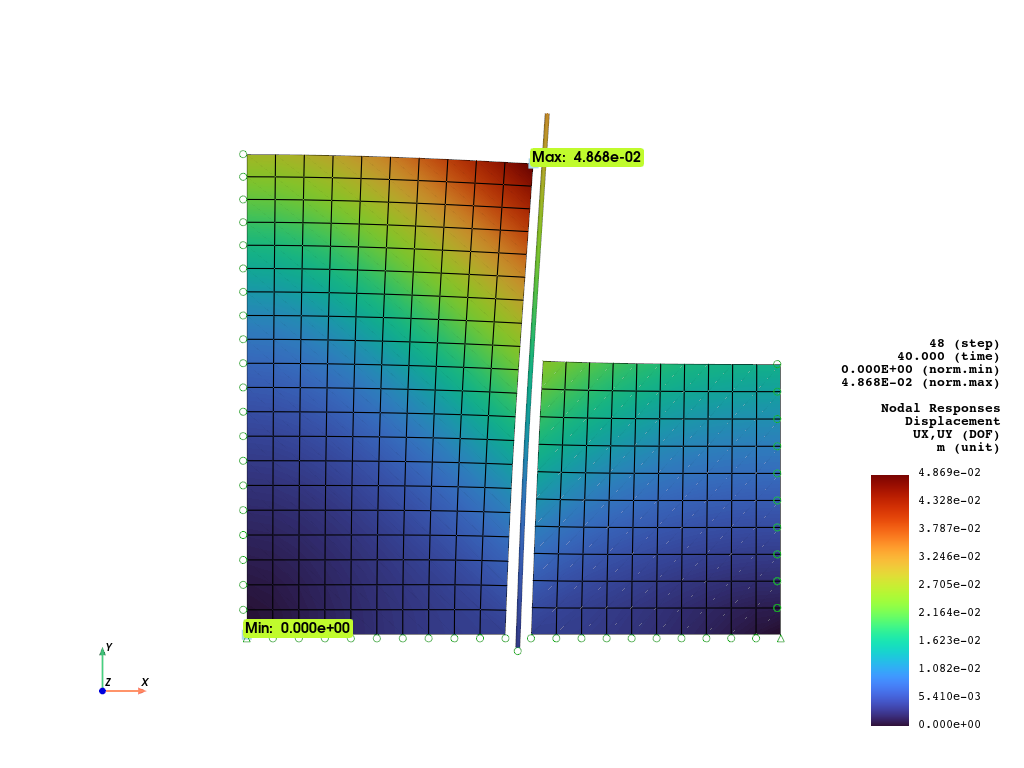
OPSTOOL™ :: Loading responses data from G:\opstool\docs\.opstool.output\RespStepData-1.odb ...
We can create animations:
fig = opsvis.plot_nodal_responses_animation(
    odb_tag=1,
    framerate=20,
    defo_scale=25,
    savefig="images/NodalRespAnimation-excavation.gif",
    resp_type="disp",
    resp_dof=["UX", "UY"],
    unit_symbol="m",
)
fig.close()
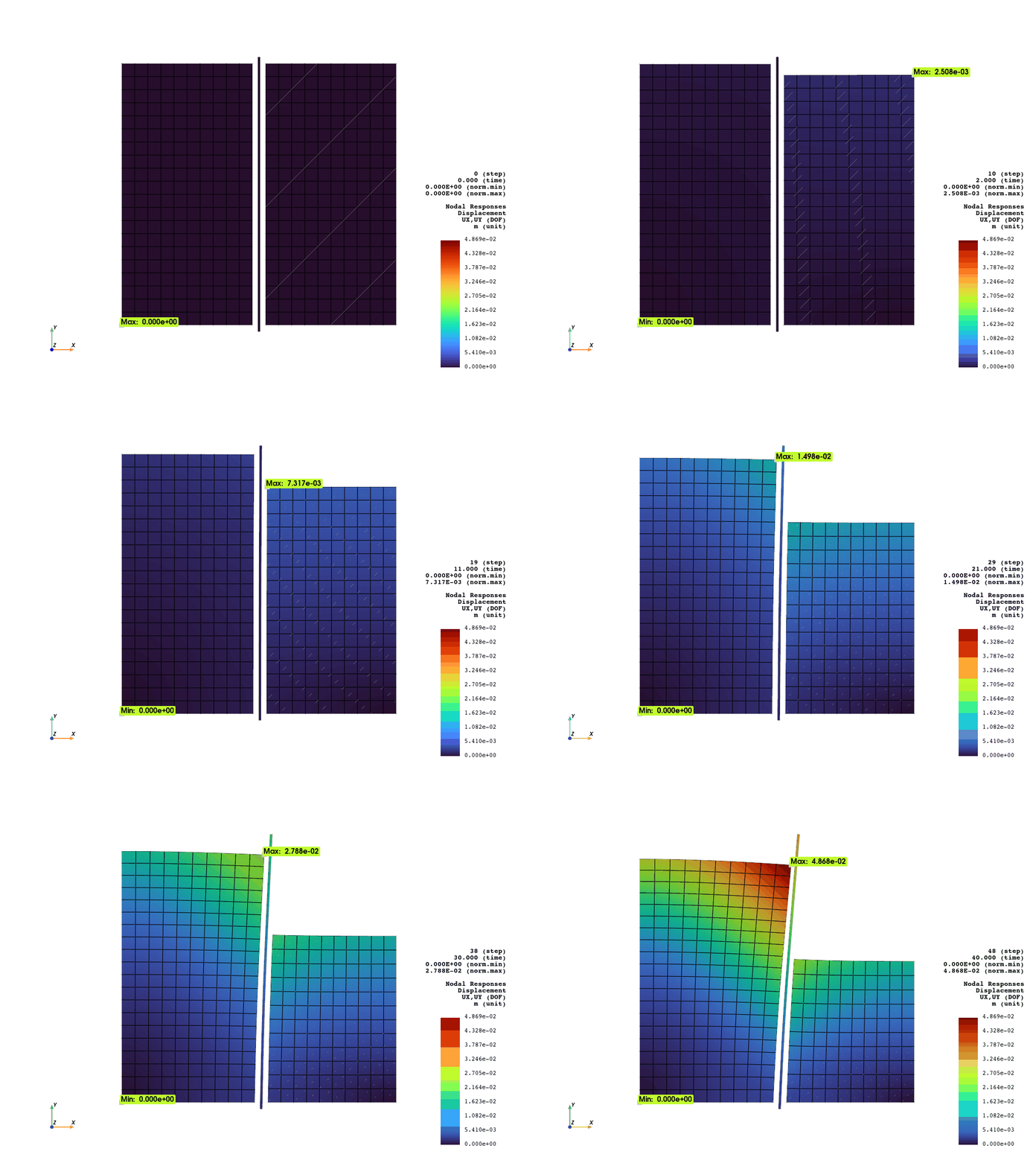
OPSTOOL™ ::  Loading responses data from G:\opstool\docs\.opstool.output\RespStepData-1.odb ...
Animation has been saved to images/NodalRespAnimation-excavation.gif!
Frame elements responses
plotter = opsvis.plot_frame_responses(
    odb_tag=1,
    resp_type="sectionForces",
    resp_dof="MZ",
    unit_symbol="kN·m",
    show_values="eleMaxMin",
    scale=3,
    slides=True,
    style="surface",
    show_model=False,  # plot all model
    opacity=1.0,
    show_bc=False,
)
plotter.show()
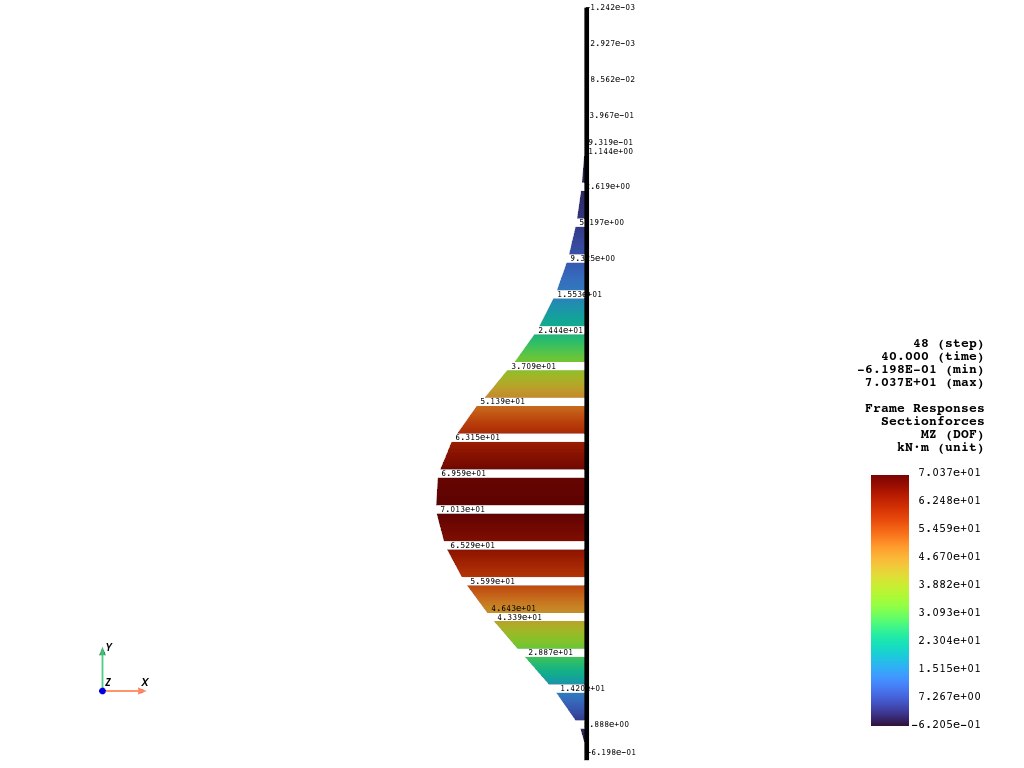
OPSTOOL™ :: Loading responses data from G:\opstool\docs\.opstool.output\RespStepData-1.odb ...
opsvis.plot_frame_responses_animation(
    odb_tag=1,
    resp_type="sectionForces",
    resp_dof="MZ",
    unit_symbol="kN·m",
    show_values=False,
    framerate=20,
    scale=3,
    style="surface",
    opacity=1.0,
    show_model=True,  # plot all model
    show_bc=False,
    savefig="images/FrameForcesMZ-excavation.gif",
).close()
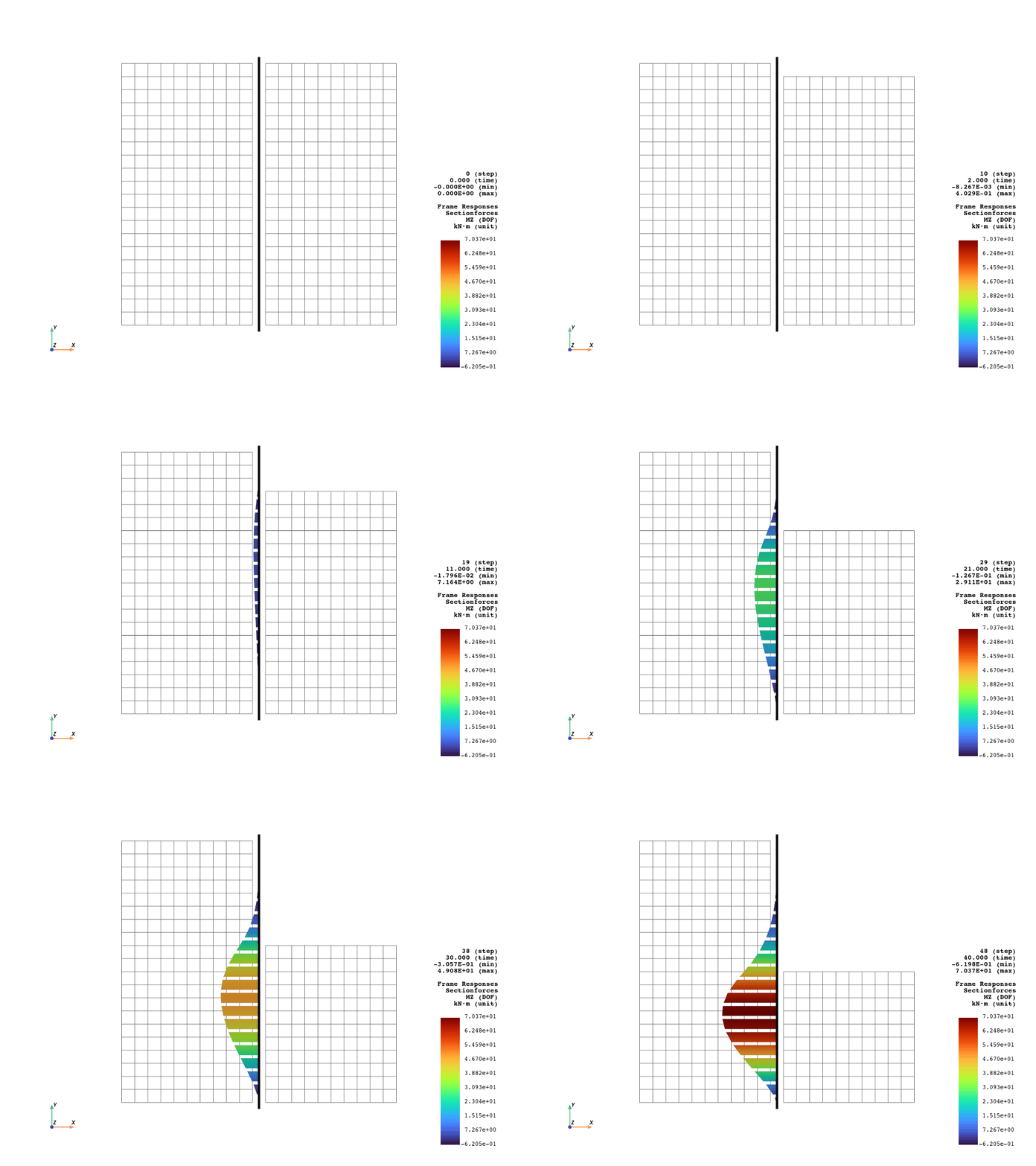
OPSTOOL™ ::  Loading responses data from G:\opstool\docs\.opstool.output\RespStepData-1.odb ...
Animation has been saved as images/FrameForcesMZ-excavation.gif!
Plane elements response
pl = opsvis.plot_unstruct_responses(
    odb_tag=1, slides=True, ele_type="Plane", resp_type="StressesAtNodes", resp_dof="sigma22", unit_symbol="kPa"
)
pl.show()
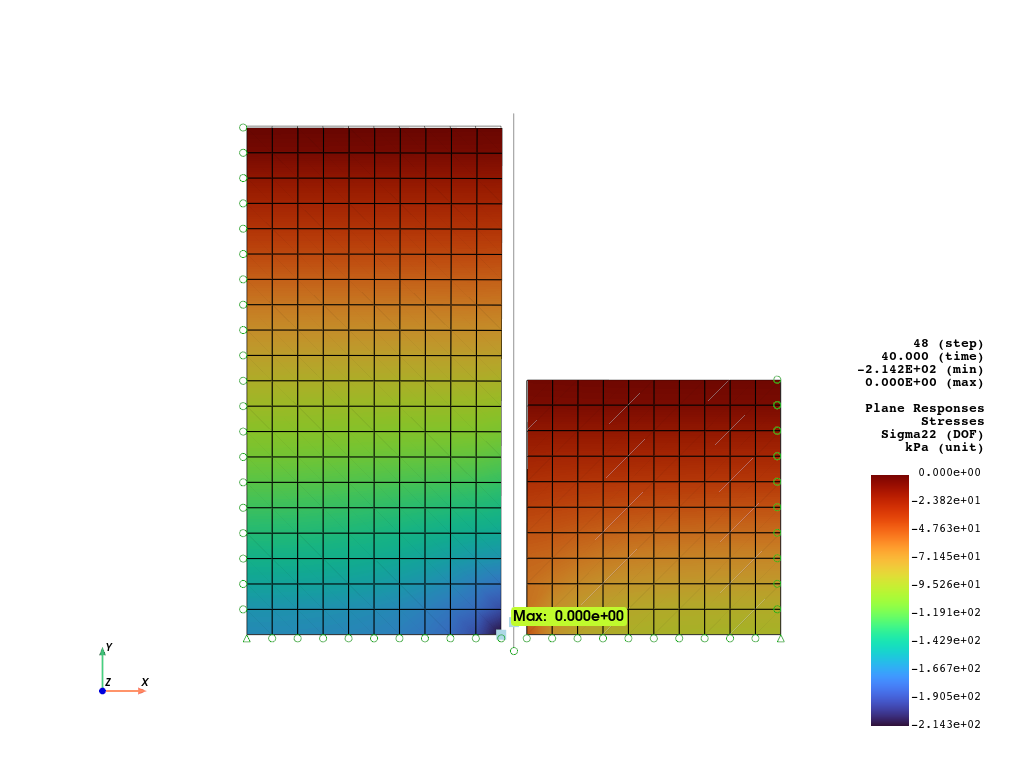
OPSTOOL™ :: Loading responses data from G:\opstool\docs\.opstool.output\RespStepData-1.odb ...
opsvis.set_plot_props(show_mesh_edges=False)
opsvis.plot_unstruct_responses(
    odb_tag=1,
    slides=True,
    ele_type="Plane",
    resp_type="StressesAtNodes",
    resp_dof="sigma12",
    show_defo=True,
    defo_scale=30,
    unit_symbol="MPa",
).show()
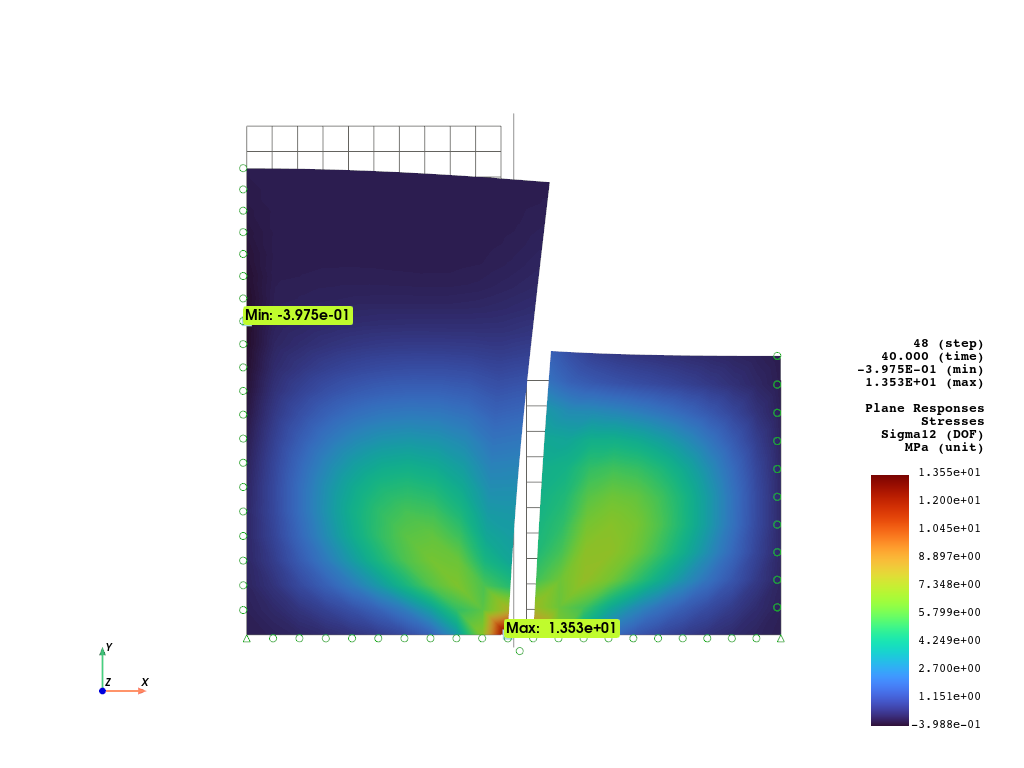
OPSTOOL™ :: Loading responses data from G:\opstool\docs\.opstool.output\RespStepData-1.odb ...
opsvis.plot_unstruct_responses(
    odb_tag=1, slides=True, ele_type="Plane", resp_type="StressesAtNodes", resp_dof="sigma_vm"
).show()
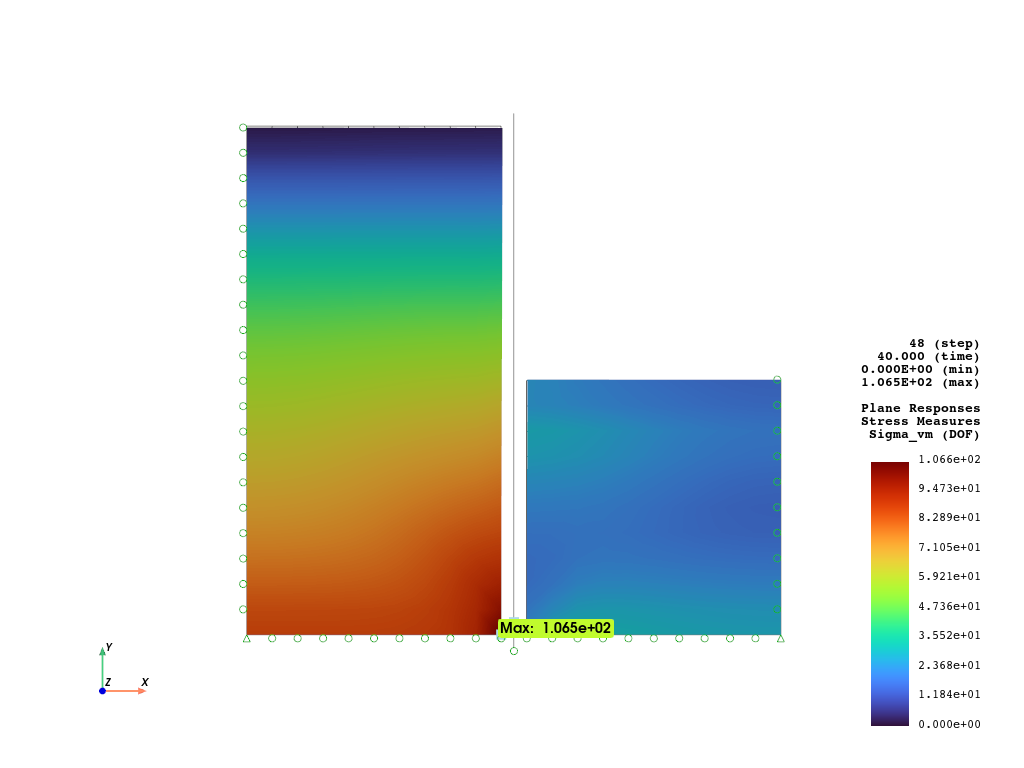
OPSTOOL™ :: Loading responses data from G:\opstool\docs\.opstool.output\RespStepData-1.odb ...
Read data from ODB
Reading the nodal displacements
data = opst.post.get_nodal_responses(odb_tag=1, resp_type="disp")
data.isel(time=41).dropna(dim="nodeTags", how="all")  # drop nodes with all NaN values
OPSTOOL™ :: Loading disp response data from G:\opstool\docs\.opstool.output\RespStepData-1.odb ...
Reading the response of the contact element
data = opst.post.get_element_responses(odb_tag=1, ele_type="Contact")
data
OPSTOOL™ :: Loading Contact response data from G:\opstool\docs\.opstool.output\RespStepData-1.odb ...
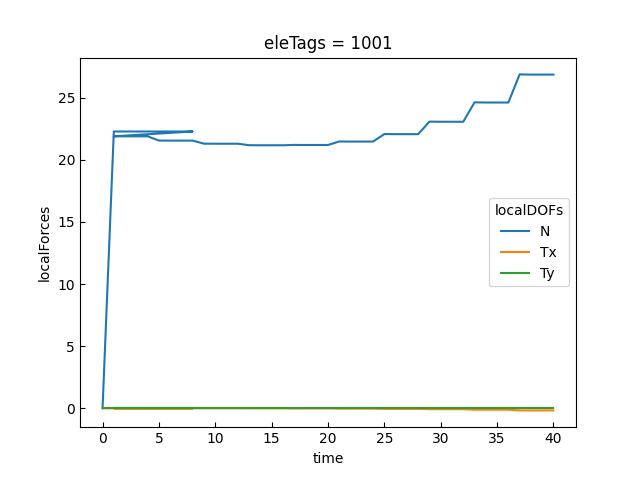
data["localForces"].sel(eleTags=1001).plot.line(x="time")
plt.show()
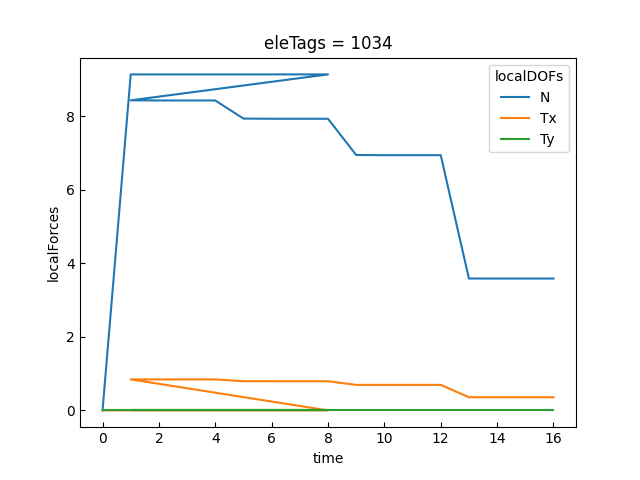
Let’s examine the response of contact element #1034.
Since it is removed during the fifth lift, its response is truncated at time=16,
and subsequent data will be filled with numpy.nan.
data["localForces"].sel(eleTags=1034).plot.line(x="time")
plt.show()
data["localForces"].sel(eleTags=1034).data
Reading the response of the beam element
data = opst.post.get_element_responses(odb_tag=1, ele_type="Frame")
print(data)
OPSTOOL™ ::  Loading Frame response data from G:\opstool\docs\.opstool.output\RespStepData-1.odb ...
<xarray.Dataset> Size: 309kB
Dimensions:              (time: 49, eleTags: 21, basicDofs: 6, localDofs: 12,
                          secPoints: 3, secDofs: 6, locs: 3)
Coordinates:
  * time                 (time) float32 196B 0.0 1.0 2.0 3.0 ... 38.0 39.0 40.0
  * eleTags              (eleTags) int64 168B 401 402 403 404 ... 419 420 421
  * basicDofs            (basicDofs) <U3 72B 'N' 'MZ1' 'MZ2' 'MY1' 'MY2' 'T'
  * localDofs            (localDofs) <U3 144B 'FX1' 'FY1' 'FZ1' ... 'MY2' 'MZ2'
  * secPoints            (secPoints) int64 24B 1 2 3
  * secDofs              (secDofs) <U2 48B 'N' 'MZ' 'VY' 'MY' 'VZ' 'T'
  * locs                 (locs) <U5 60B 'alpha' 'X' 'Y'
Data variables:
    basicDeformations    (time, eleTags, basicDofs) float32 25kB 0.0 ... 0.0
    basicForces          (time, eleTags, basicDofs) float32 25kB 0.0 ... 0.0
    localForces          (time, eleTags, localDofs) float32 49kB -0.0 ... 0.0...
    plasticDeformation   (time, eleTags, basicDofs) float32 25kB 0.0 ... 0.0
    sectionDeformations  (time, eleTags, secPoints, secDofs) float32 74kB 0.0...
    sectionForces        (time, eleTags, secPoints, secDofs) float32 74kB 0.0...
    sectionLocs          (time, eleTags, secPoints, locs) float32 37kB 0.1127...
Attributes:
    localDofs:  local coord system dofs at end 1 and end 2
    basicDofs:  basic coord system dofs at end 1 and end 2
    secPoints:  section points No.
    secDofs:    section forces and deformations Dofs. Note that the section D...
    Notes:      Note that the deformations are displacements and rotations in...
data = opst.post.get_element_responses(odb_tag=1, ele_type="Plane")
data
OPSTOOL™ :: Loading Plane response data from G:\opstool\docs\.opstool.output\RespStepData-1.odb ...
Total running time of the script: (0 minutes 55.356 seconds)