Shell Element Responses (Pyvista)
[ ]:
import openseespy.opensees as ops

import opstool as opst
import opstool.vis.pyvista as opsvis
Model and gravity load
[ ]:
opst.load_ops_examples("Shell3D")

ops.timeSeries("Linear", 1)
ops.pattern("Plain", 1, 1)
_ = opst.pre.gen_grav_load(direction="Z", factor=-9810)
The original Tcl file comes from http://www.dinochen.com/, and the Python version is converted by opstool.tcl2py().
[ ]:
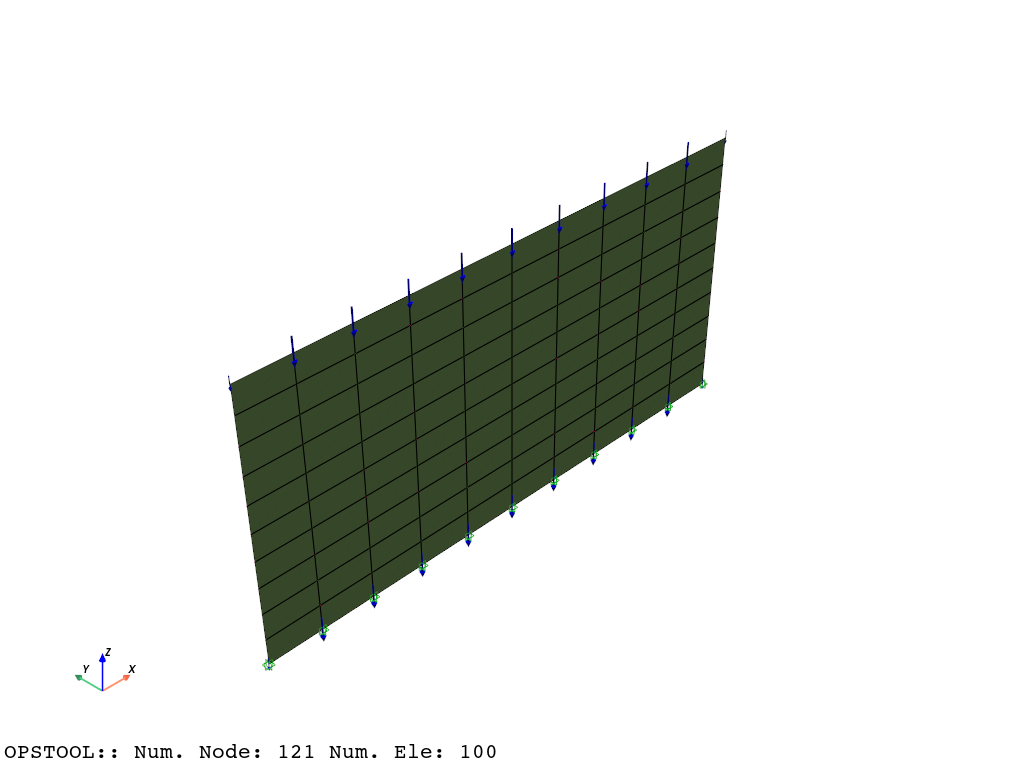
opsvis.set_plot_props(point_size=0, line_width=3, notebook=True)  # notebook=False for practical use
fig = opsvis.plot_model(show_nodal_loads=True, show_ele_loads=True)
fig.show(jupyter_backend="jupyterlab")
# fig.show()
Gravity analysis
[ ]:
ops.constraints("Transformation")
ops.numberer("RCM")
ops.system("BandGeneral")
ops.test("NormDispIncr", 1.0e-8, 6, 2)
ops.algorithm("Linear")
ops.integrator("LoadControl", 0.1)
ops.analysis("Static")
Save the responses
[ ]:
ODB = opst.post.CreateODB(
    odb_tag=1,
    project_gauss_to_nodes="copy",  # project gauss point responses to nodes, optional ["copy", "average", "extrapolate"]
)
for _ in range(10):
    ops.analyze(1)
    ODB.fetch_response_step()
ODB.save_response()
OPSTOOL :: All responses data with _odb_tag = 1 saved in .opstool.output/RespStepData-1.nc!
Visualize the results
Nodal responses, project_gauss_to_nodes needs to be set to “copy”, “average”, or “extrapolate” when creating the ODB
[ ]:
opsvis.set_plot_props(cmap="coolwarm_r", show_mesh_edges=True, notebook=True)

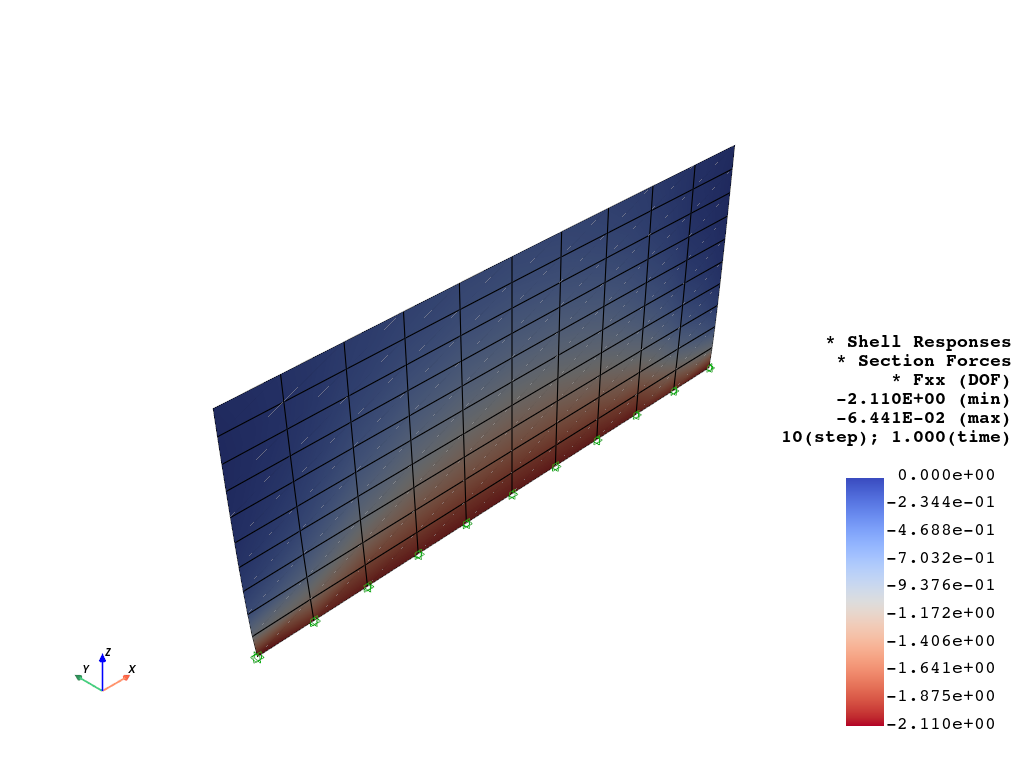
fig = opsvis.plot_unstruct_responses(
    odb_tag=1,
    slides=False,
    step="absMax",
    ele_type="Shell",
    resp_type="sectionForcesAtNodes",  # nodal response, "AtNodes"
    resp_dof="FXX",
)
fig.show(jupyter_backend="jupyterlab")
# fig.show()
OPSTOOL :: Loading response data from .opstool.output/RespStepData-1.nc ...
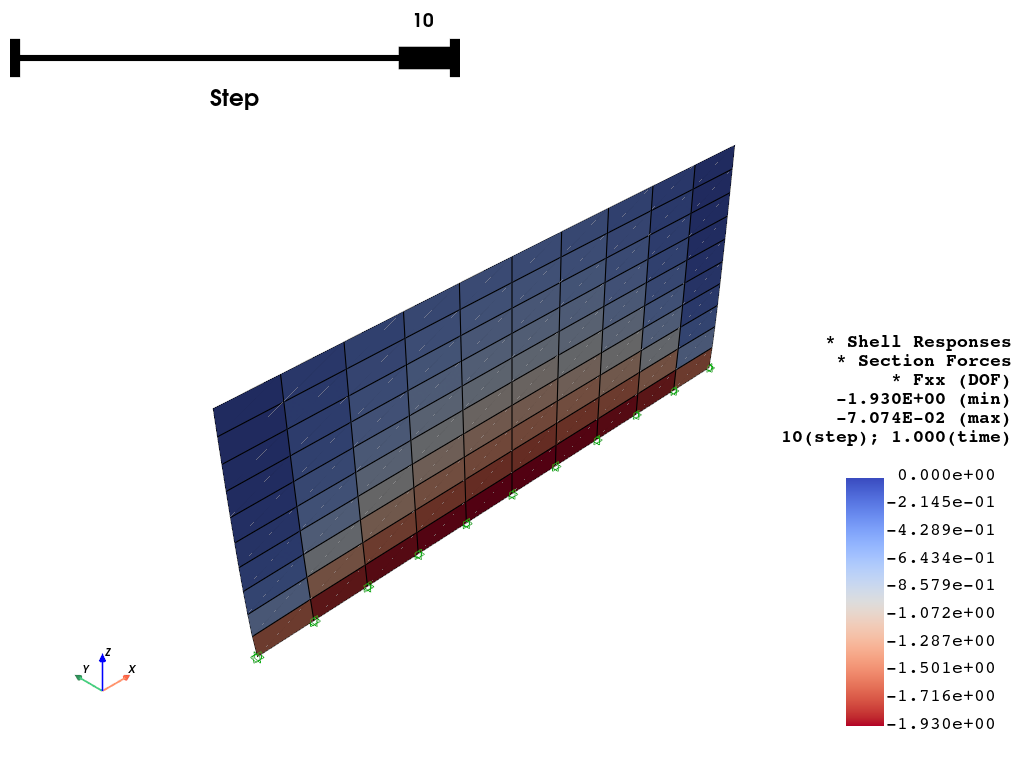
Display the responses at each element, all gauss points will be averaged to the element level.
[ ]:
fig = opsvis.plot_unstruct_responses(
    odb_tag=1,
    slides=True,
    ele_type="Shell",
    resp_type="sectionForces",  # element response, "AtGaussPoints", will be averaged to each element
    resp_dof="FXX",
)
fig.show(jupyter_backend="jupyterlab")
OPSTOOL :: Loading response data from .opstool.output/RespStepData-1.nc ...
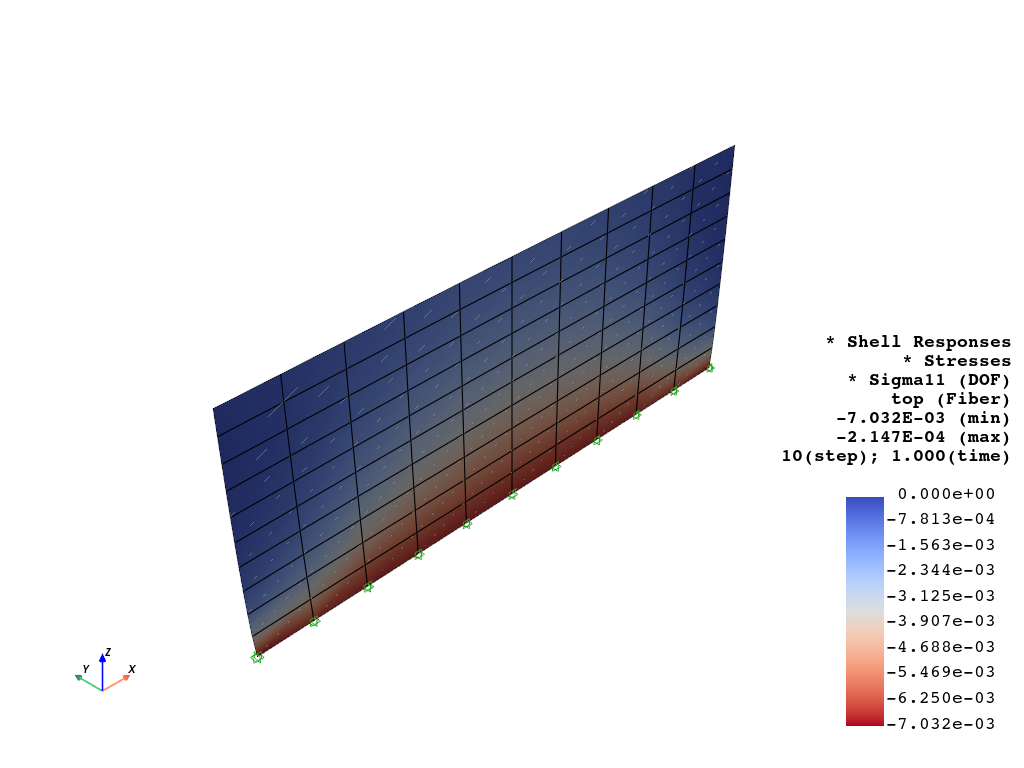
Fiber point stress can be plotted as well, but it requires a shell_fiber_loc to be assigned.
[ ]:
fig = opsvis.plot_unstruct_responses(
    odb_tag=1,
    slides=False,
    step="absMax",
    ele_type="Shell",
    resp_type="StressesAtNodes",  # nodal stress response, "AtNodes"
    resp_dof="sigma11",  # sigma11, sigma22, sigma12, sigma13, sigma23
    shell_fiber_loc="top",  # shell_fiber_loc can be "top", "bottom", or "mid" for shell elements, also int
)
fig.show(jupyter_backend="jupyterlab")
OPSTOOL :: Loading response data from .opstool.output/RespStepData-1.nc ...