Nodal Responses Visualization (Pyvista)
[1]:
import openseespy.opensees as ops

import opstool as opst
import opstool.vis.pyvista as opsvis
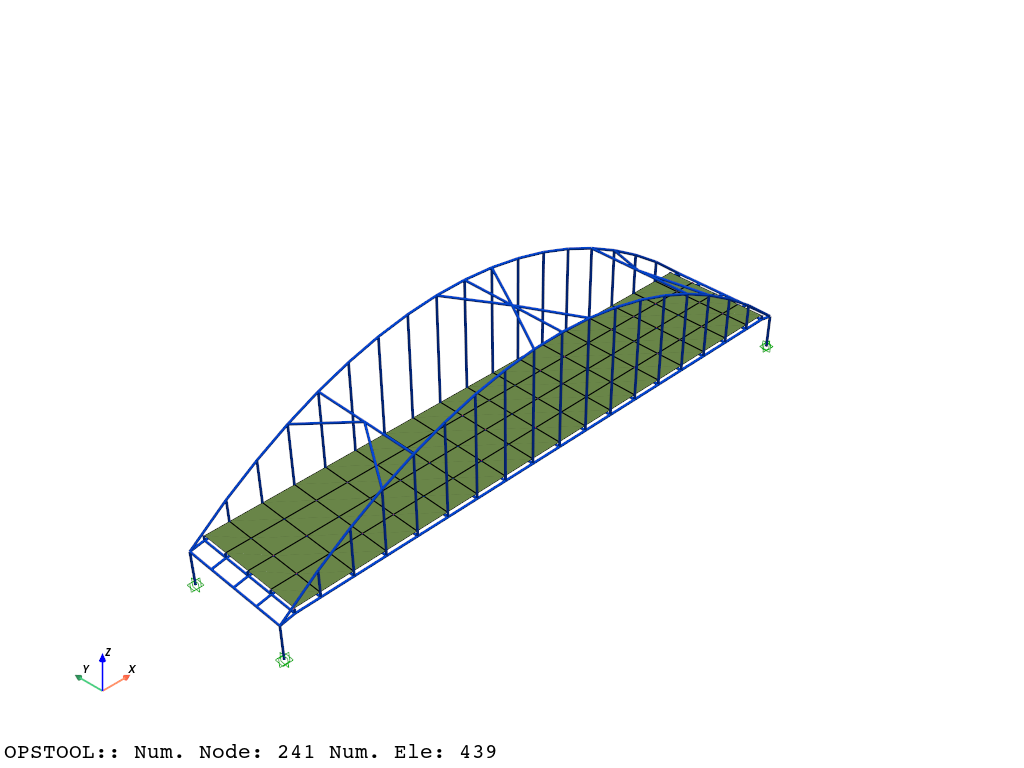
Here, we use a built-in example from opstool, which is an example of a deck arch bridge model primarily composed of frame elements and shell elements.
[2]:
opst.load_ops_examples("ArchBridge2")
# or your model code here
We use the opstool.vis.plotly.set_plot_props() function to predefine some common visualization properties, which will affect all subsequent visualizations of models, eigenvalues, and responses.
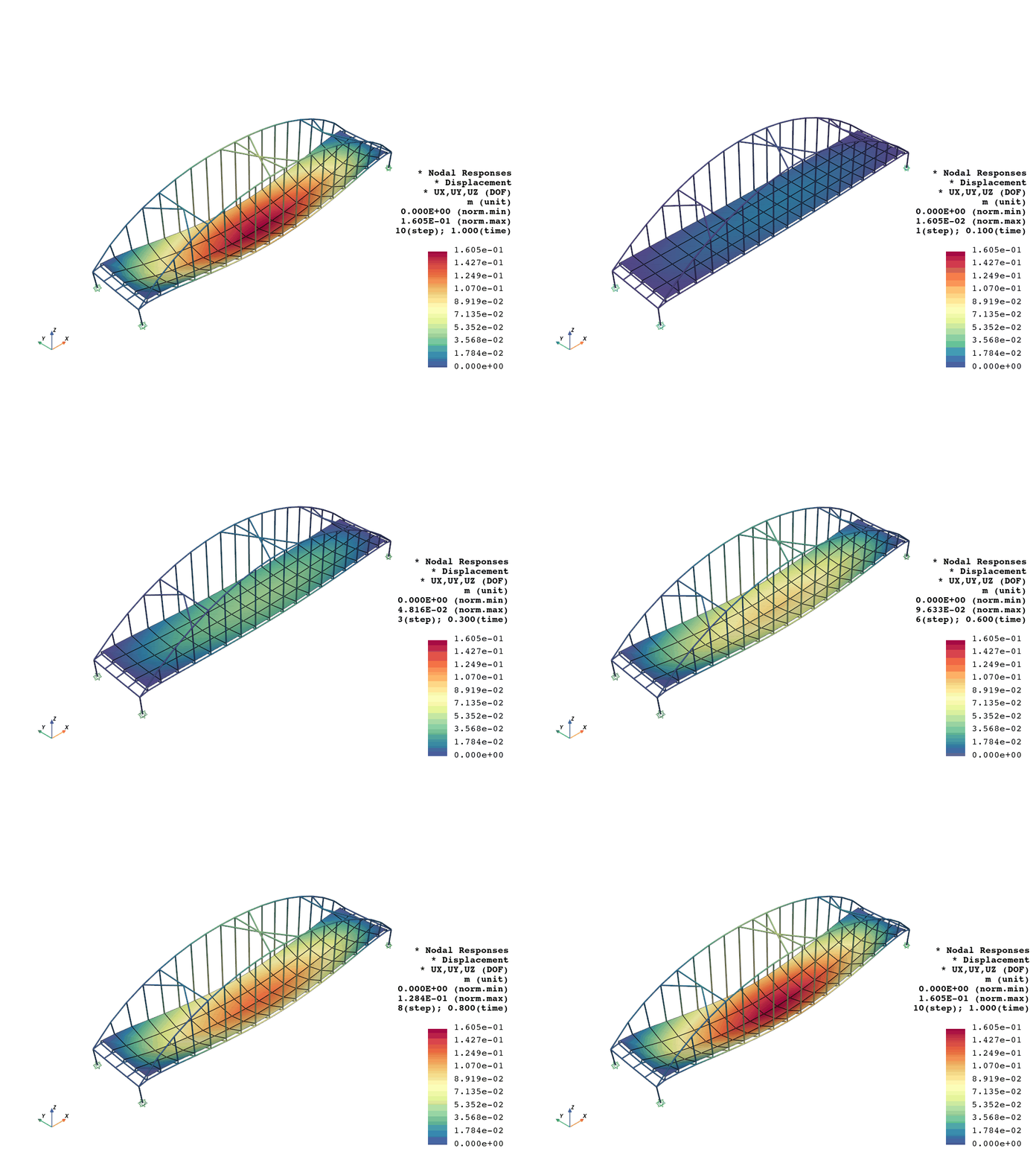
[3]:
opsvis.set_plot_props(
    point_size=0,
    line_width=3,
    notebook=True,  # Set to False for practical use, display in a separate window
)
[4]:
fig = opsvis.plot_model()
fig.show(jupyter_backend="jupyterlab")
# fig.show()
[5]:
ops.timeSeries("Linear", 1)
ops.pattern("Plain", 1, 1)
_ = opst.pre.gen_grav_load(factor=-9810)
[6]:
ops.system("BandGeneral")
# Create the constraint handler, the transformation method
ops.constraints("Transformation")
# Create the DOF numberer, the reverse Cuthill-McKee algorithm
ops.numberer("RCM")
# Create the convergence test, the norm of the residual with a tolerance of
# 1e-12 and a max number of iterations of 10
ops.test("NormDispIncr", 1.0e-12, 10, 3)
# Create the solution algorithm, a Newton-Raphson algorithm
ops.algorithm("Newton")
# Create the integration scheme, the LoadControl scheme using steps of 0.1
ops.integrator("LoadControl", 0.1)
# Create the analysis object
ops.analysis("Static")
[7]:
ODB = opst.post.CreateODB(odb_tag=1)
for i in range(10):
    ops.analyze(1)
    ODB.fetch_response_step()
ODB.save_response()
OPSTOOL :: All responses data with _odb_tag = 1 saved in .opstool.output/RespStepData-1.nc!
[8]:
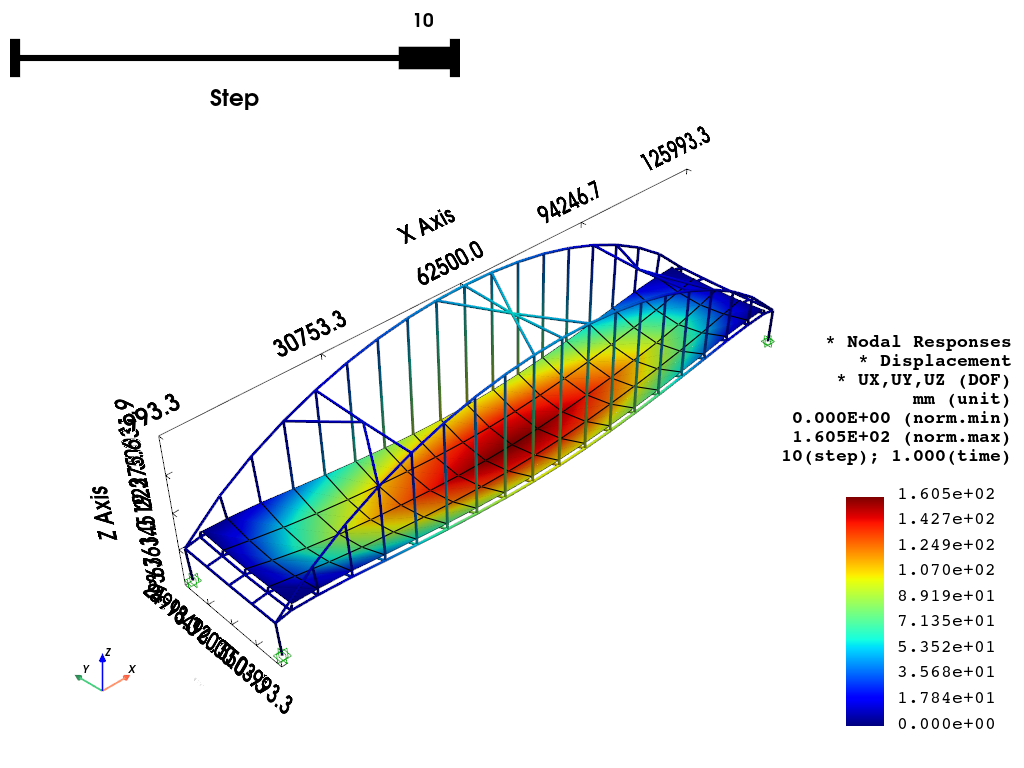
fig = opsvis.plot_nodal_responses(
    odb_tag=1, slides=True, resp_type="disp", resp_dof=["UX", "UY", "UZ"], unit_symbol="mm", show_outline=True
)
fig.show(jupyter_backend="jupyterlab")
# fig.show()
OPSTOOL :: Loading response data from .opstool.output/RespStepData-1.nc ...
[9]:
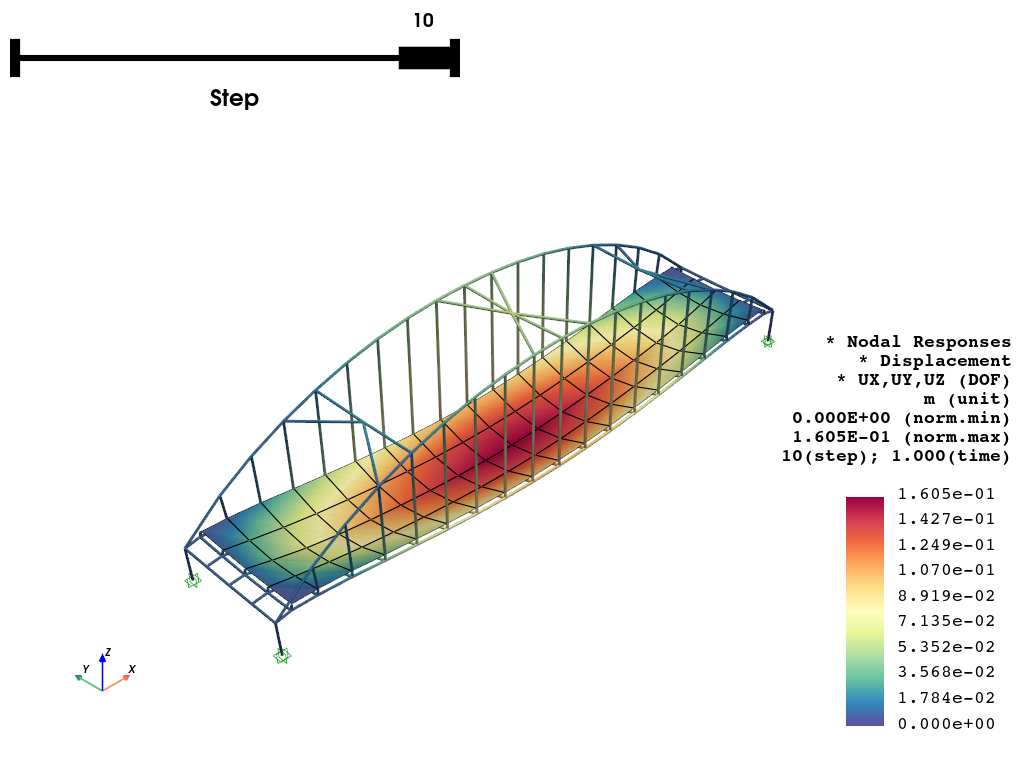
opsvis.set_plot_colors(cmap="Spectral_r")
fig = opsvis.plot_nodal_responses(
    odb_tag=1, slides=True, step=9, resp_type="disp", resp_dof=["UX", "UY", "UZ"], unit_symbol="m", unit_factor=1e-3
)
fig.show(jupyter_backend="jupyterlab")
# fig.show()
OPSTOOL :: Loading response data from .opstool.output/RespStepData-1.nc ...
[10]:
fig = opsvis.plot_nodal_responses_animation(
    odb_tag=1,
    framerate=2,
    scale=1.5,
    savefig="images/NodalRespAnimation.gif",
    resp_type="disp",
    resp_dof=["UX", "UY", "UZ"],
    unit_symbol="m",
    unit_factor=1e-3,
)
fig.close()
OPSTOOL :: Loading response data from .opstool.output/RespStepData-1.nc ...
Animation has been saved to images/NodalRespAnimation.gif!