RC section mesh
Here we regard the RC section as a single-material section, ignoring the different material properties of steel bars and concrete.
[13]:
import numpy as np
from opstool.preprocessing import SecMesh, Rebars, add_polygon, add_circle, offset
Generate geometric objects
Functions: offset() and add_polygon() are used.
[14]:
# the points of the outer contour line, only the turning point of the line is needed, counterclockwise or clockwise.
outlines = [[0.5, 0], [7.5, 0], [8, 0.5], [8, 4.5],
            [7.5, 5], [0.5, 5], [0, 4.5], [0, 0.5]]
# cover thick
cover_d = 0.08
# Offset to get the inner boundary of the cover layer
coverlines = offset(outlines, d=cover_d)

# Generate polygonal geometry object for cover layer
cover = add_polygon(outlines, holes=[coverlines])

# Creating core with voids
holelines1 = [[1, 1], [3.5, 1], [3.5, 4], [1, 4]]
holelines2 = [[4.5, 1], [7, 1], [7, 4], [4.5, 4]]
core = add_polygon(coverlines, holes=[holelines1, holelines2])
Generate mesh
by class SecMesh.
[15]:
sec = SecMesh(sec_name="My Fiber Section")
# Grouping, the dict key is the group name, which can be arbitrary.
sec.assign_group(dict(cover=cover, core=core))
# Specify the grid size
sec.assign_mesh_size(dict(cover=0.2, core=0.4))
sec.assign_group_color(dict(cover="gray", core="green"))
# Specify the material tag in the opensees, the material needs to be defined by you beforehand.
sec.assign_ops_matTag(dict(cover=1, core=2))
# mesh!
sec.mesh()
add rebars
by class Rebars.
[16]:
# Instantiating the rebar class
rebars = Rebars()

rebar_d_outer = 0.032   # dia of rebar
rebar_d_inner = 0.02
# Offset to obtain the rebars arranged along the contour line, Inward offset is positive
rebar_lines1 = offset(outlines, d=cover_d + rebar_d_outer / 2)
# add the rebar line, gap is the spacing of the rebars, matTag is the opensees material tag predefined.
rebars.add_rebar_line(
    points=rebar_lines1, dia=rebar_d_outer, gap=0.15, color="red", matTag=3
)
# Offset to obtain the rebars arranged along the holes
rebar_lines2 = offset(holelines1, d=-(cover_d + rebar_d_inner / 2))
rebars.add_rebar_line(
    points=rebar_lines2, dia=rebar_d_inner, gap=0.2, color="black", matTag=3
)
rebar_lines3 = offset(holelines2, d=-(cover_d + rebar_d_inner / 2))
rebars.add_rebar_line(
    points=rebar_lines3, dia=rebar_d_inner, gap=0.2, color="black", matTag=3
)
[17]:
# add to the sec
sec.add_rebars(rebars)
Get the section properties
section props dict, including:
Cross-sectional area (A)
Shear area (Asy, Asz)
Elastic centroid (centroid)
Second moments of area about the centroidal axis (Iy, Iz, Iyz)
Torsion constant (J)
Principal axis angle (phi)
ratio of reinforcement (rho_rebar)
Effective Material Properties (Effective elastic modulus: E_eff; Effective shear modulus: G_eff; Effective Poisson’s ratio: Nu_eff)
Tip
Since the finite element method is used to calculate the section properties by sectionproperties pacakge, the calculation may be a bit slow, which can be ignored if there is no need to calculate the section properties.
[18]:
sec_props = sec.get_sec_props(display_results=False, plot_centroids=False)
for key, value in sec_props.items():
    print(f"{key}: {value}")
A: 24.500000000000004
Asy: 13.962700538339337
Asz: 12.118680669217847
centroid: (3.999999999999998, 2.499999999999999)
Iy: 69.35416666666686
Iz: 152.2291666666673
Iyz: 5.684341886080802e-14
J: 158.25255667724676
phi: -89.99999999999997
rho_rebar: 0.006746858737195126
E_eff: 1.0
G_eff: 0.5
Nu_eff: 0.0
centering or rotate the section
Note
centring and rotate need run get_sec_props() method, if get_sec_props() has not run in advance!
[19]:
sec.centring()
#sec.rotate(90)
View the section mesh
engine=’plotly’
[8]:
sec.view(fill=True, engine='plotly', save_html=None, on_notebook=True)
and engine=‘matplotlib’
[9]:
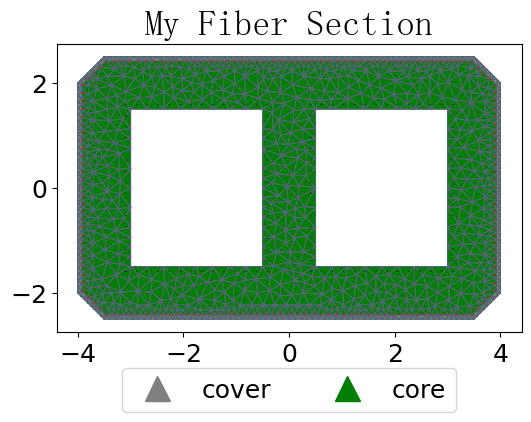
sec.view(fill=True, engine='matplotlib')
Generate py or tcl file
[10]:
G = 10000   # Shear modulus
sec.to_file("mysec.py", secTag=1, GJ=G * sec_props['J'])
# sec.to_file("mysec.tcl", secTag=1, GJ=G * sec_props['J'])
Generate openseespy cmds implicitly
This command can be used after defining the OpenSees material.
G = 10000   # Shear modulus
sec.opspy_cmds(secTag=1, GJ=G * sec_props['J'])
It’s done, you don’t need to do anything more.
Composite Section Mesh
Of course, we can also build composite material fiber sections, we need to use function add_material().
[22]:
import numpy as np
from opstool.preprocessing import SecMesh, add_material, add_polygon, add_circle, offset, Rebars
Specify the characteristics of each material
[23]:
# case 9
Ec = 3.45E7
Es = 2.0E8
Nus = 0.3
Nuc = 0.2
steel_mat = add_material(name='steel', elastic_modulus=Es, poissons_ratio=Nus)
conc_mat = add_material(name='conc', elastic_modulus=Ec, poissons_ratio=Nuc)
Use predefined materials when generating geometric objects
[24]:
outlines = [[0, 0], [2, 0], [2, 2], [0, 2]]
coverlines = offset(outlines, d=0.05)
cover = add_polygon(outlines, holes=[coverlines], material=conc_mat)
bonelines = [[0.5, 0.5], [1.5, 0.5], [1.5, 0.7], [1.1, 0.7], [1.1, 1.3], [1.5, 1.3], [1.5, 1.5],
             [0.5, 1.5], [0.5, 1.3], [0.9, 1.3], [0.9, 0.7], [0.5, 0.7], [0.5, 0.5]]
core = add_polygon(coverlines, holes=[bonelines], material=conc_mat)
bone = add_polygon(bonelines, material=steel_mat)
mesh
[25]:
sec = SecMesh()
sec.assign_group(dict(cover=cover, core=core, bone=bone))
sec.assign_mesh_size(dict(cover=0.02, core=0.05, bone=0.02))
sec.assign_group_color(dict(cover="gray", core="blue", bone='yellow'))
sec.assign_ops_matTag(dict(cover=1, core=2, bone=4))
sec.mesh()
D:\AcademicSoft\Anaconda3\lib\site-packages\sectionproperties\analysis\section.py:198: ShapelyDeprecationWarning:

STRtree will be changed in 2.0.0 and will not be compatible with versions < 2.
add rebars
[26]:
# add rebars
rebars = Rebars()
rebar_lines1 = offset(outlines, d=0.05 + 0.032 / 2)
rebars.add_rebar_line(
    points=rebar_lines1, dia=0.032, gap=0.1, color="red", matTag=3
)
# add to the sec
sec.add_rebars(rebars)
Important
Use the modulus of elasticity to convert the geometric properties of the composite section into the equivalent properties of the reference material. Here, steel bar.
[27]:
sec_props = sec.get_sec_props(Eref=Es, display_results=False)
[28]:
sec.centring()
sec.view(fill=True, engine='plotly', save_html=None, on_notebook=True)
output the file
[29]:
Gs = Es / 2 / (1 + Nus)
sec.to_file("mysec.py", secTag=1, GJ=Gs * sec_props['J'])